
Ramping Up By Removing Friction
Conversations - not prompts - have been working for me

Sooo…. for most of the past 15 years, I’ve had way more ideas to write about than I could ever get down. Sometimes the blocker was resistance (fear / doubt / perfectionism) or the overwhelm of too many ideas. Other times, with a family I just had other priorities to juggle!
The balance between ideas and time/energy kept shifting:
2005–2010: lots of ideas, lots of energy/time to share
2011–2017: lots of ideas, little energy/time
2018–2021: few ideas, little energy/time
2022–2025: tons of ideas, little energy/time
Two big unlocks in the past 3 years changed that:
Getting away for a few days at writing retreats like Moniack Mhor or Heriot Toun here in Scotland.
(Cue Frozen soundtrack) “For the first time in forever’' …all our kids are in the same school for the same hours - meaning a few days a week with actual space to work!
I started to feel some space and writing energy come back. Even so, with a big family and life in motion, there’s always something unplanned: a sick kid, a broken boiler, a dog emergency…
That’s AI has quietly become a game-changer at the “intake and organisation” part of my process. I’m still a bit shocked at how helpful it’s been!?
Because rather than “work harder” (easy to say, hard to actually do for anyone) I’m speeding up by removing friction and juicing creativity. This post is an example on ‘removing friction’ - in a small step, but with a big impact…
I used to record ideas into a voice app and later transcribe them, pasting / collecting them in different google docs.
Now I record straight into ChatGPT and have it instantly turn my rough thoughts into something structured. I don’t use prompts / prompt engineering. I just let some stories or ideas flow into it, without having to overthink any initial structure.
I have each book and business idea in a separate project, and aim to keep chats somewhat separate based on the goal of the chat. So one chat might be about the overall list of frameworks for the book, another various stories, or a specific topic:
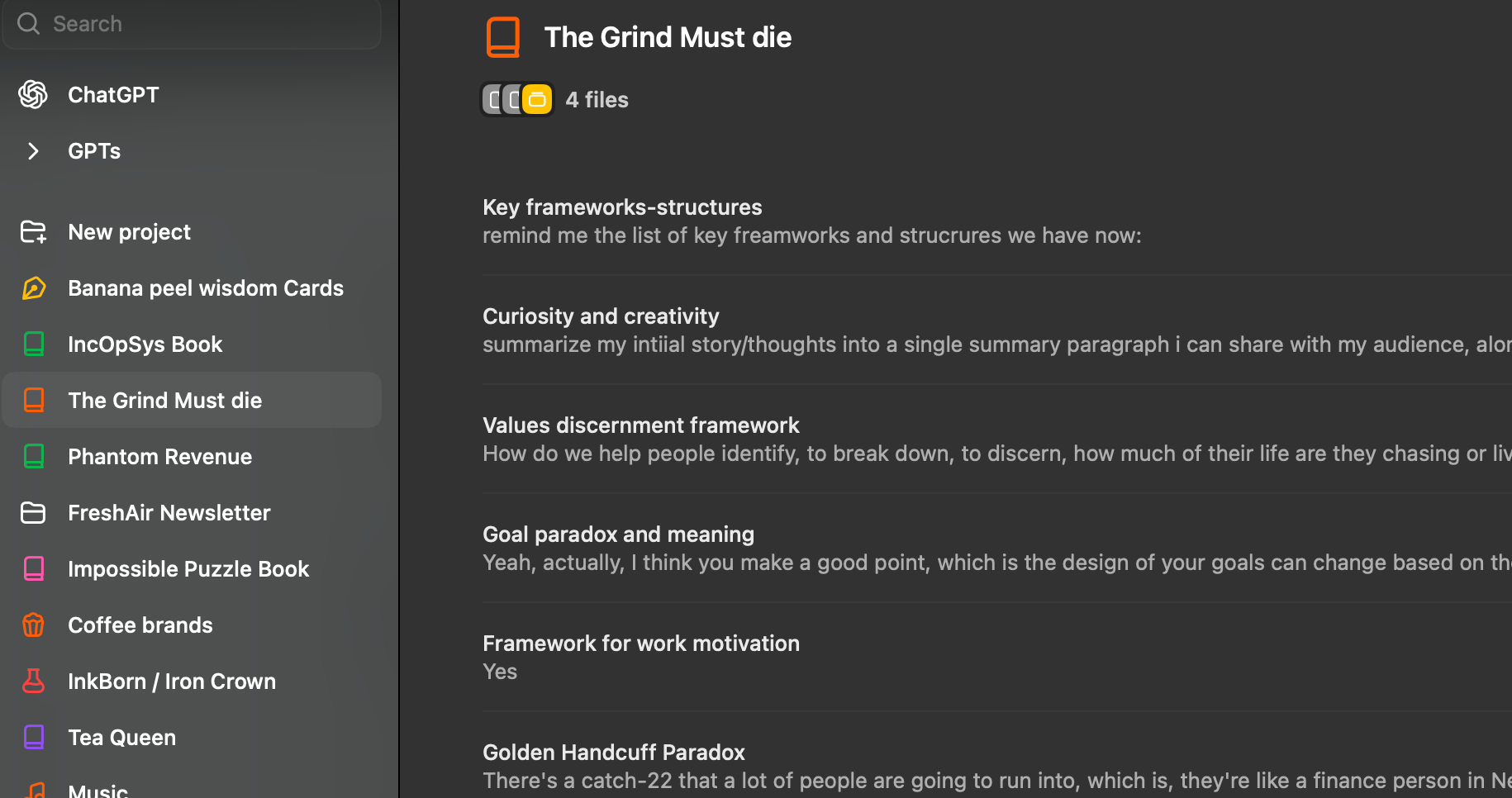
To leave you with a specific example, here’s part of the raw note I voice-recorded into ChatGPT: “I know that one of the key unlocks for people going through this process is tapping into this area of curiosity or interestingness, following your interests. This is something we’re often discouraged while younger in life. The stereotype is the artist who is discouraged from doing art because he can’t make money of that, and so they become a lawyer. As thinking back, I think I’ve always tended to follow my interests to some extent, doing computer programming when I was younger in high school, and then to engineering, and then to business and banking, and so on. I know following my interests was more important than the salary or the title. later I lost that creativity in the obligation to make money… ” etc etc - I go on for awhile longer :)
I pasted the actual output & draft framework at the bottom of this post, it was so good. Will I copy and paste this into a book? No. It’s just the beginning of a conversation I have with AI and with my human partners & readers. And I’ll still sketch stuff out in notebooks, as another way to think visually.
Is it a huge leap from having to first draft both the content and possible structures? Hell yes.
Now it seems like such as simple change, but it’s changed how I create. That “little” bit of friction removed hasn’t been little at all!
It’s why I feel excited about all the books I’m working on now, and then I can see getting at least three out in the next year (starting with Income Operating System in late 2025).
Here’s the output. It’s 98% exactly what came out, I couldn’t help but do a few tweaks and format changes…
This’ll be a part of the “The Grind Must Die” book (goal: late 2026)
Module: Curiosity as the Spark
1. The Problem: The DEATH OF CURIOSITY
Most people lose touch with curiosity long before they lose energy.
It’s trained out of us early: “Be practical.” “Pick a real job.”
We learn to chase validation, salary, and status—external metrics of worth.
Over time, we forget what genuinely interests us. We stop asking, “What do I want to learn?” and replace it with “What should I do?”
This is the quiet beginning of The Grind: motion without meaning.
2. The Shift: From OBLIGATION to INTEREST
After burnout, “finding your passion” is too big a leap.
Curiosity is smaller, lighter, safer to reach for.
It doesn’t demand a plan.
It doesn’t promise income.
It just asks for attention.
Curiosity is a bridge between exhaustion and engagement.
“When you can’t feel passion, follow what feels interesting or curious. It’s the first sign your energy is coming back online.”
3. The Practice: Follow the Sparks
Look for twinkles, glimmers, and whispers.
They’re not fireworks—just small signals of aliveness.
Twinkles: micro-moments of interest (a topic, a person, a sentence).
Glimmers: recurring pulls or patterns that keep resurfacing.
Whispers: intuitions that feel right but make no rational sense.
Follow them experimentally: one call, one article, one walk.
You don’t need to “find your thing.” You’re rebuilding your radar.
4. The Payoff: Energy Before Answers
When you follow curiosity, energy returns before clarity does.
That energy fuels creativity, and creativity attracts opportunity.
Money follows curiosity now more than ever—because the world rewards originality, not imitation.
“Curiosity creates emotional profitability, which later compounds into financial profitability.”
5. The Takeaway Slide / Quote
Curiosity is the first spark.
It’s not the fire itself—it’s the match that makes the next fire possible.
:)
Aaron